

DOI码:10.1016/j.ipm.2025.104474
发表刊物:Information Processing & Management
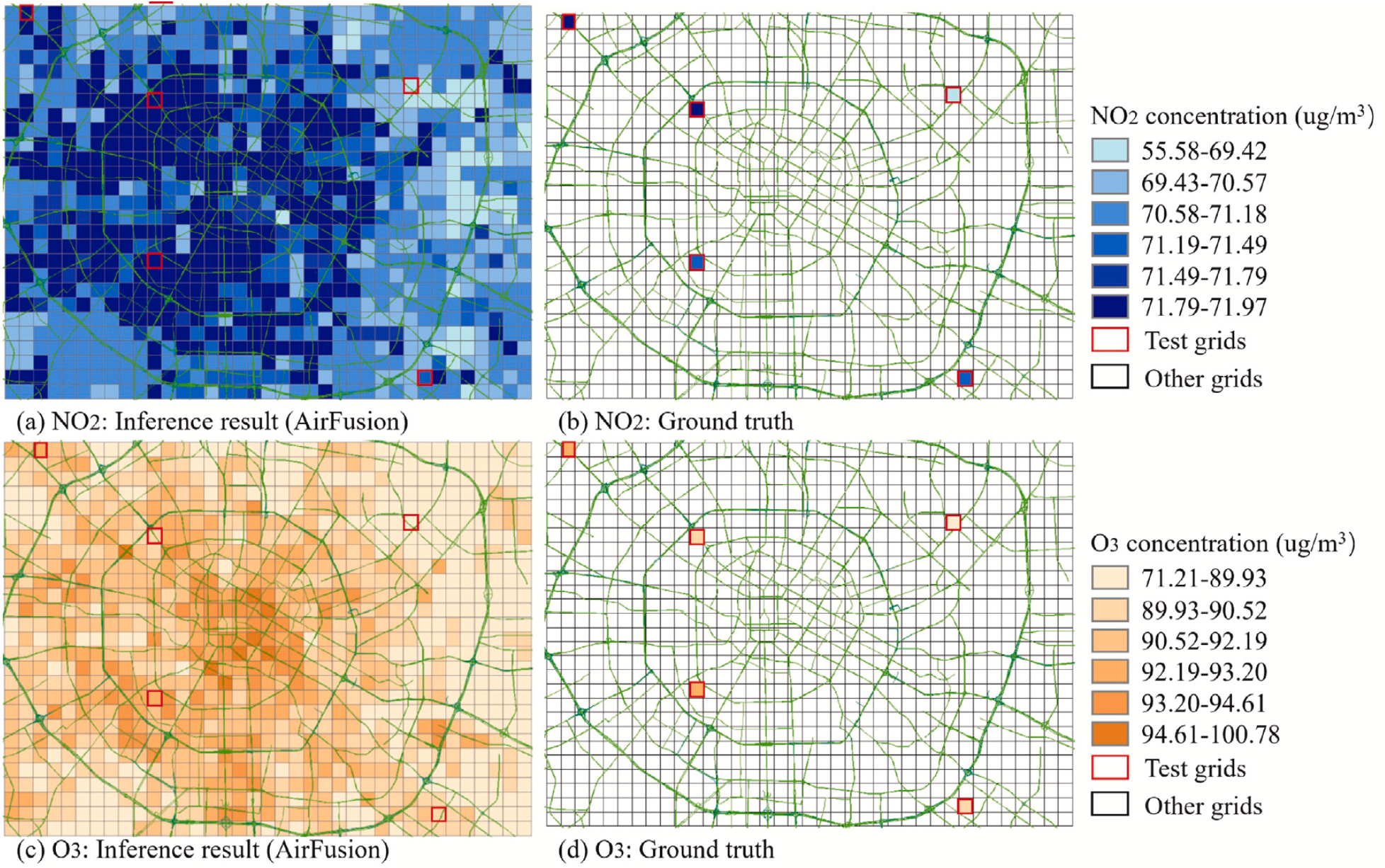
摘要:Air quality inference is constrained by label scarcity due to the sparse distribution of standardized monitoring stations, yet existing studies rarely focus on this limitation. Consequently, we introduce AirFusion, a novel multi-task framework that integrates a supervised task for core inference with a self-supervised task for learning representations from unlabeled data. To capture the complex nature of air pollution, AirFusion employs a multi-source data fusion module consisting of five feature extraction blocks covering air quality, meteorology, traffic, geography, and timestamps. A key innovation is the air quality block, which fuses data from both standardized stations (high quality but low quantity) and micro-stations (low quality but high quantity) to enhance complementarity, providing the empirical support for ongoing micro-station deployment. To efficiently manage the vast multi-source features, we propose Adaptive Feature Selection Loss (AFSLoss), a novel loss function that prioritizes key features while filtering out irrelevant ones. Unlike previous methods limited to continuous features, AFSLoss effectively handles both continuous and categorical features. Extensive experiments on NO2 , O3 , and PM2.5 datasets (each containing 743,256 samples) demonstrate that AirFusion outperforms baselines.
论文类型:期刊论文
论文编号:104474
卷号:63
期号:2
是否译文:否
发表时间:2025-11-08
收录刊物:SCI
发布期刊链接:https://www.sciencedirect.com/science/article/pii/S0306457325004157
 报考该导师研究生的方式