

DOI码:10.1080/23249935.2025.2561061
发表刊物:Transportmetrica A: Transport Science
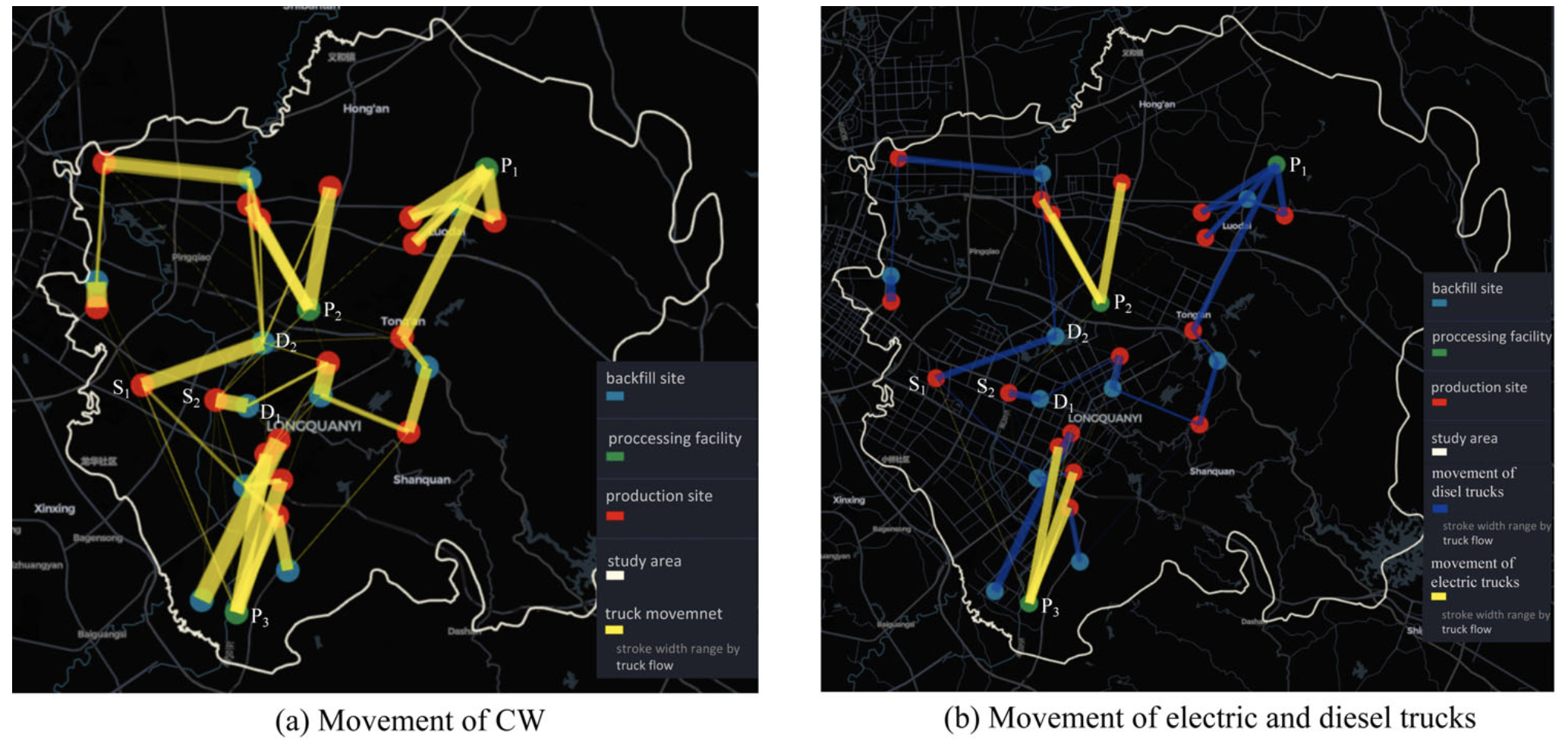
摘要:More than 10 billion tons of construction and demolition waste (CW) are generated globally each year, which has a non-negligible impact on the environment. In the recycling process of the CW, government and the carrier are two main stakeholders. The carrier is responsible for transporting the CW from production sites to backfill sites or processing facilities, whose main concern is the economic benefits and transport efficiency. Meanwhile, the government, as the regulator, focuses on minimising pollution generated by the recycling system, which is influenced by transport modes, shipment distances, and the types of processing facilities used. This paper develops a bi-level optimisation model to address these challenges. The upper-level model optimises the government’s subsidy scheme, while the lower-level model focuses on the carrier’s recycling plan. With the introduction of the time-space network, the lower-level model is formulated as a tailored minimum cost flow problem and the upper-level problem as a linear programming model. Due to the complex structure and large number of variables of the problem, we design a hybrid heuristic method. A case study in Chengdu demonstrates that the lower-level model could achieve a gap less than 0.43% within 58 s, and the whole problem could be solved with a gap of less than 1.51% within 3.76 h. Results show that with an optimised subsidy scheme and recycling plan, pollution can be reduced by over 29.29% with a relatively small subsidy investment.
论文类型:期刊论文
是否译文:否
发表时间:2025-09-29
收录刊物:SCI
发布期刊链接:https://www.tandfonline.com/doi/full/10.1080/23249935.2025.2561061
 报考该导师研究生的方式