

DOI码:10.1007/s00530-026-02695-y
教研室:TURBO LAB - 交通与城市运行实验室
发表刊物:Multimedia Systems
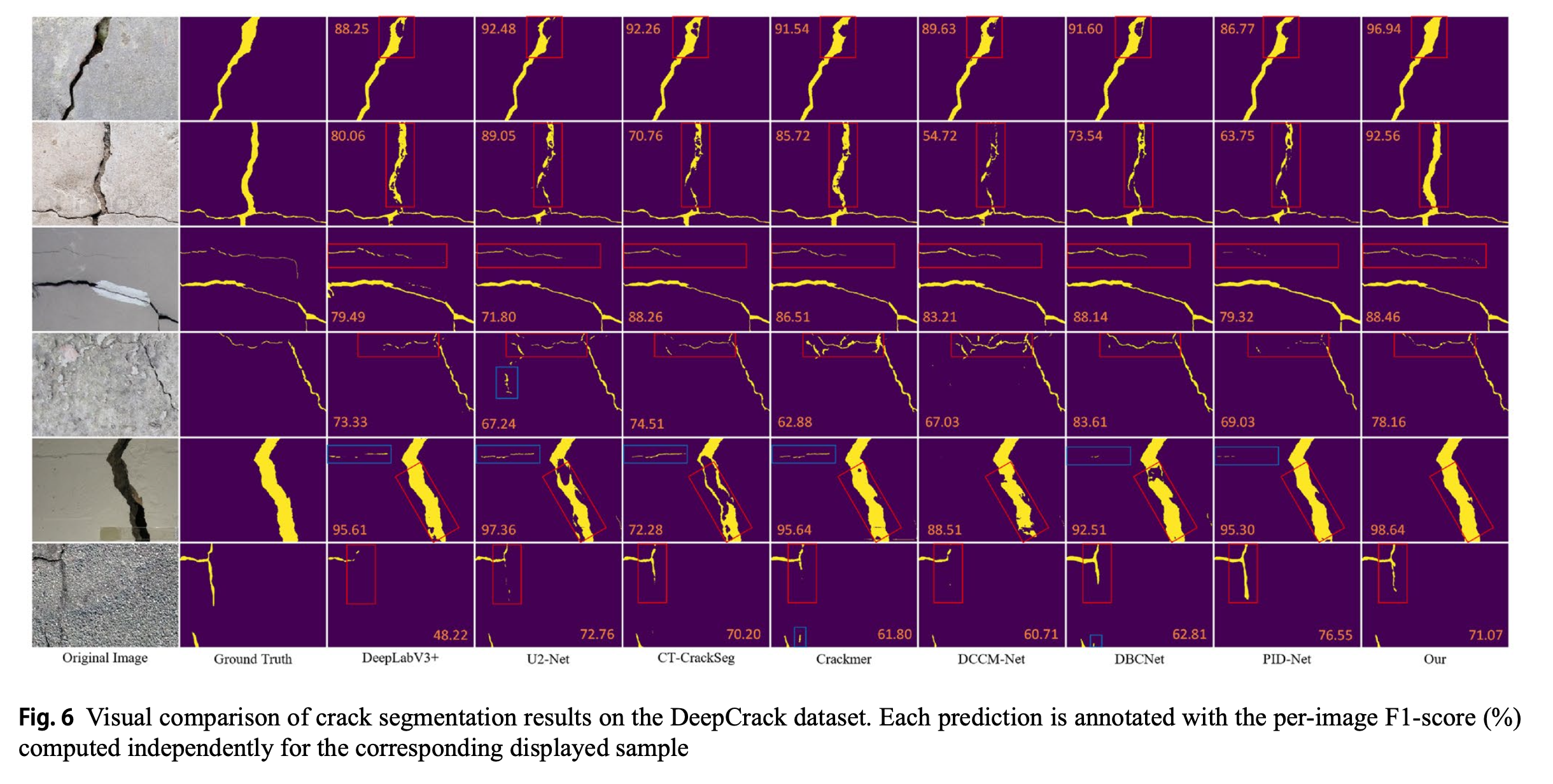
摘要:Accurate pavement crack segmentation requires weak branches and fine boundaries to be preserved without sacrificing continuity across fragmented structures. Real-time inspection adds a strict efficiency constraint. Multi-scale convolution is well suited to dense local pattern extraction, whereas state-space modeling and self-attention provide broader structural and contextual interaction. Applying a complete MambaVision-to-self-attention arrangement to high-resolution feature maps, however, is computationally expensive; excessive early downsampling can instead suppress thin and low-contrast responses. This paper therefore presents LiteCrack-SHD, a lightweight network that assigns different modeling operators to different encoder stages. Multi-scale convolution is retained in the shallow high-resolution stages, while MambaVision and self-attention blocks are applied sequentially in the deeper low-resolution stages. A Nonlinear Fusion Unit strengthens feature transformation through locally conditioned gating, and a Direction-Guided Attention module recalibrates orientation-sensitive responses in the deepest encoder feature. On DeepCrack, Crack500, and BT-Crack2000, LiteCrack-SHD obtains F1-score/Crack IoU values of 87.76%/78.18%, 75.44%/60.56%, and 82.93%/70.84%, respectively. The model contains 6.33 M parameters, requires 14.35 GFLOPs, and processes 512 × 512 images at 70.46 FPS on an NVIDIA GeForce RTX 3090 GPU with a batch size of 1. Under this benchmark, LiteCrack-SHD combines strong crack-region accuracy with real-time GPU throughput.
论文类型:期刊论文
论文编号:629
卷号:32
是否译文:否
发表时间:2026-10-10
收录刊物:SCI
发布期刊链接:https://link.springer.com/article/10.1007/s00530-026-02695-y
 报考该导师研究生的方式