

DOI码:10.1016/j.tra.2026.105185
教研室:TURBO LAB - 交通与城市运行实验室
发表刊物:Transportation Research Part A: Policy and Practice
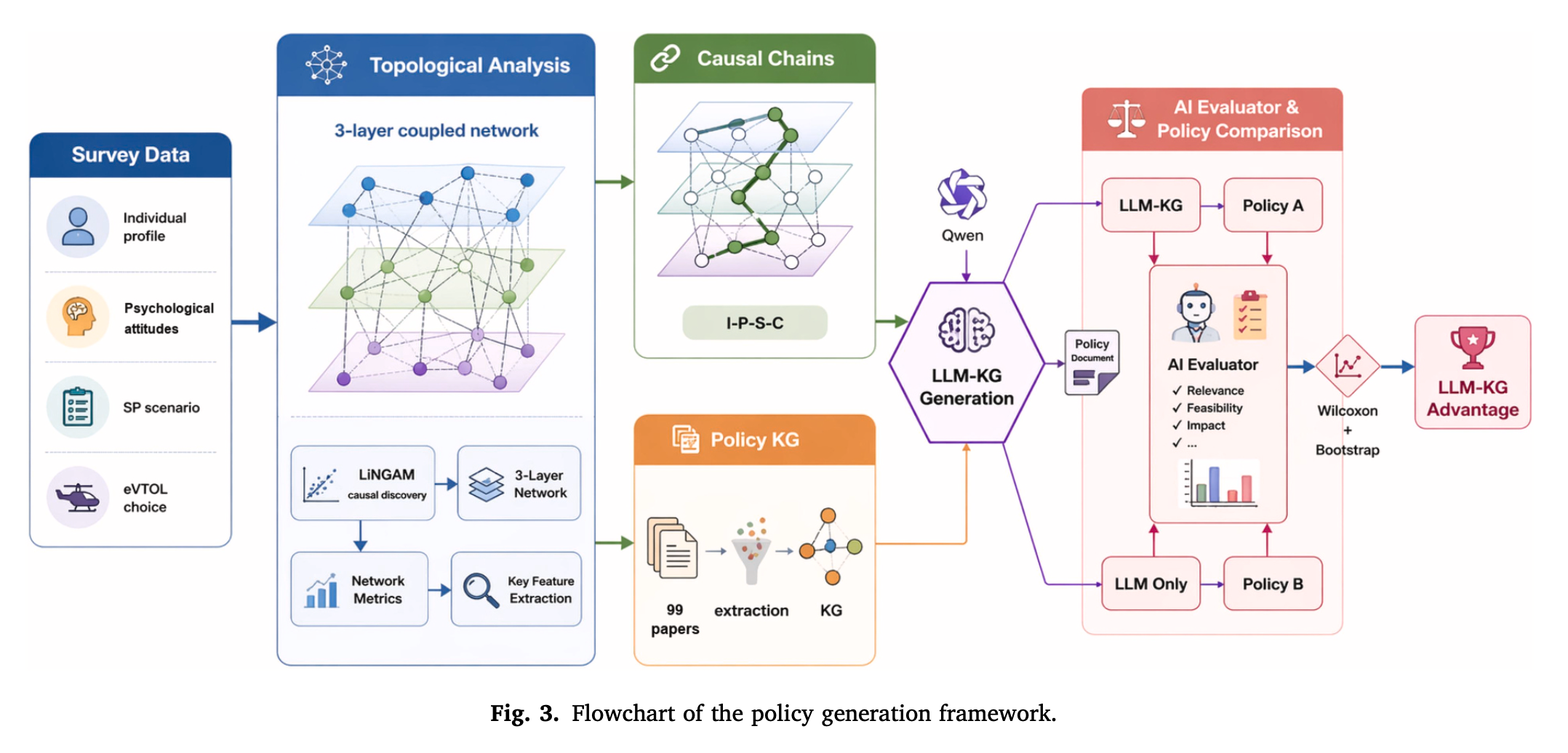
摘要:Electric vertical take-off and landing aircraft (eVTOL) may provide faster and more flexible connections for intracity and intercity trips, but their adoption depends on more than aircraft performance. Although prior studies have examined eVTOL acceptance and potential demand, the link between behavioral evidence and policy design remains underdeveloped. Using stated preference survey data from six Chinese low-altitude mobility pilot cities, covering a 30-km intracity setting and intercity settings at 60, 100, 160, and 300 km, we first construct a three-layer causal network to examine how individual characteristics, psychological attitudes, and travel-scenario attributes jointly shape eVTOL mode choice. The results show that travel cost, waiting time, and ground access/egress distance constrain eVTOL adoption, whereas perceived convenience, perceived usefulness, income, and congestion experience increase adoption potential; network analysis further identifies income and perceived usefulness as key leverage points in the decision system. Building on these behavioral findings, we develop a knowledge graph-enhanced large language model (KG-enhanced LLM) framework that integrates causal evidence and literature-based knowledge to translate the identified concerns into policy recommendations. A comparative experiment shows that the KG-enhanced LLM produces recommendations with higher evidence reliability, scenario relevance, logical coherence, and overall quality than a standalone LLM. Guided by these findings, the study recommends that eVTOL deployment prioritize transparent safety governance, accessible pricing, door-to-door integration, and differentiated communication across user groups. The study thus advances a structured approach for linking public acceptance analysis with policy design and offers methodological implications for emerging mobility systems.
论文类型:期刊论文
论文编号:105185
卷号:212
是否译文:否
发表时间:2026-08-04
收录刊物:SCI
发布期刊链接:https://doi.org/10.1016/j.tra.2026.105185
 报考该导师研究生的方式