

DOI码:10.1016/j.energy.2026.141609
发表刊物:Energy
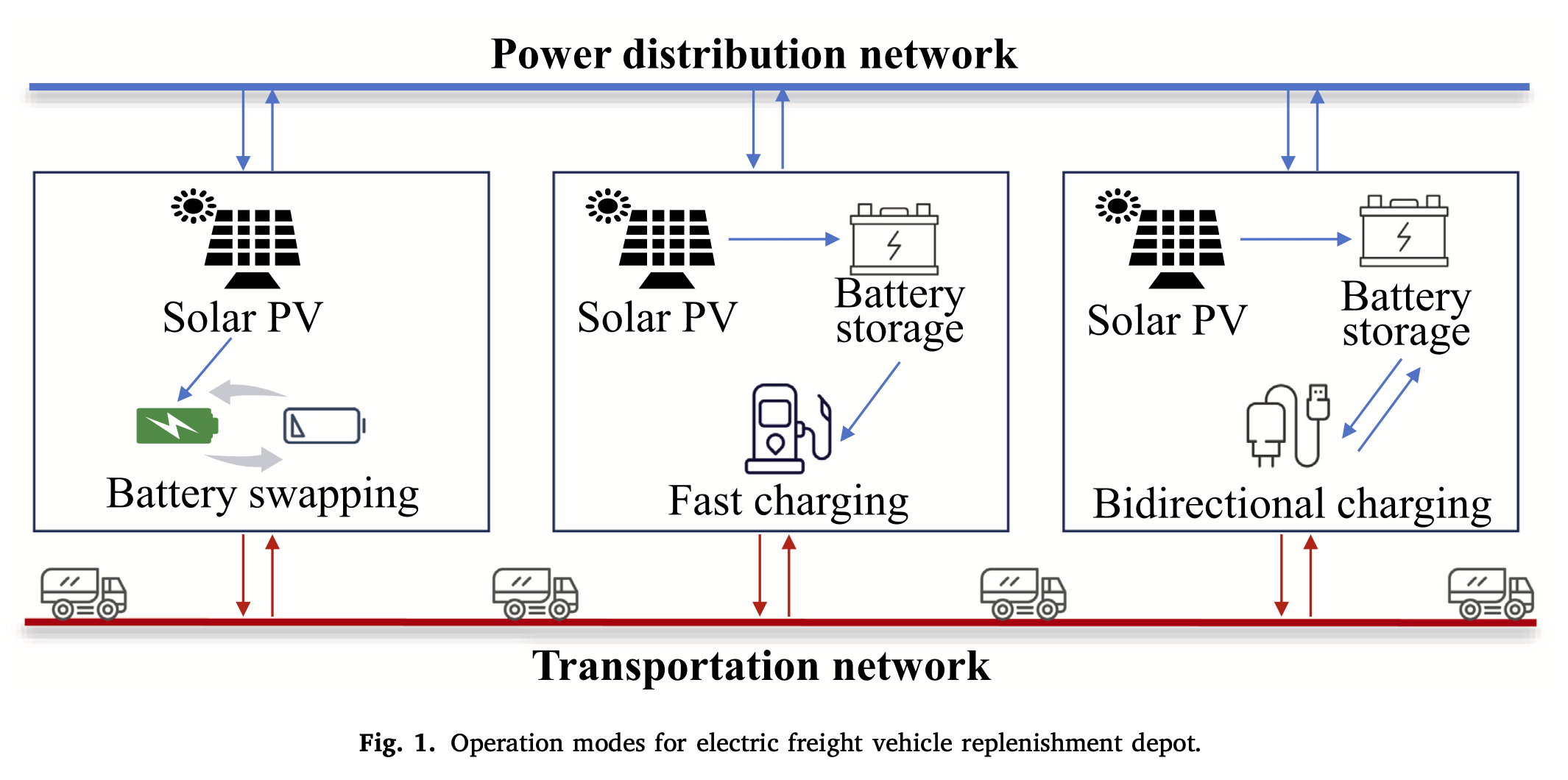
摘要:Freight electrification is critical for road transport decarbonization, yet cost-effective and grid-compatible energy replenishment for large fleets remains challenging as commercial trucks have high energy demand and tight delivery schedules. This paper develops an integrated optimization framework for freight depots to compare three replenishment modes: battery swapping, fast charging, and vehicle-to-grid operation, with optional on-site solar power and fixed battery storage. The framework co-optimizes depot energy infrastructure and transport–energy scheduling for a given transport task, using aggregated fleet energy flows to represent the interaction between vehicle operations and depot energy management. Case studies show that battery swapping achieves the highest vehicle utilization and requires the smallest fleet, whereas V2G requires more trucks but can attain the lowest total cost through electricity price arbitrage. Photovoltaic investment is attractive across all modes, but under realistic depot space constraints, solar power supplies only 2%–11% of truck charging energy. Fixed battery storage is not economically attractive for freight depots under current cost and electricity price conditions. High solar power penetration reduces the marginal value of trucks as mobile storage. Extended analyses further examine freight demand fluctuations, endogenous service demand, empirical depot arrival-departure profiles, and V2G battery degradation cost. The findings offer useful managerial and policy insights for designing freight depot replenishment systems.
论文类型:期刊论文
论文编号:141609
卷号:360
是否译文:否
发表时间:2026-06-13
收录刊物:SCI
发布期刊链接:https://doi.org/10.1016/j.energy.2026.141609
 报考该导师研究生的方式