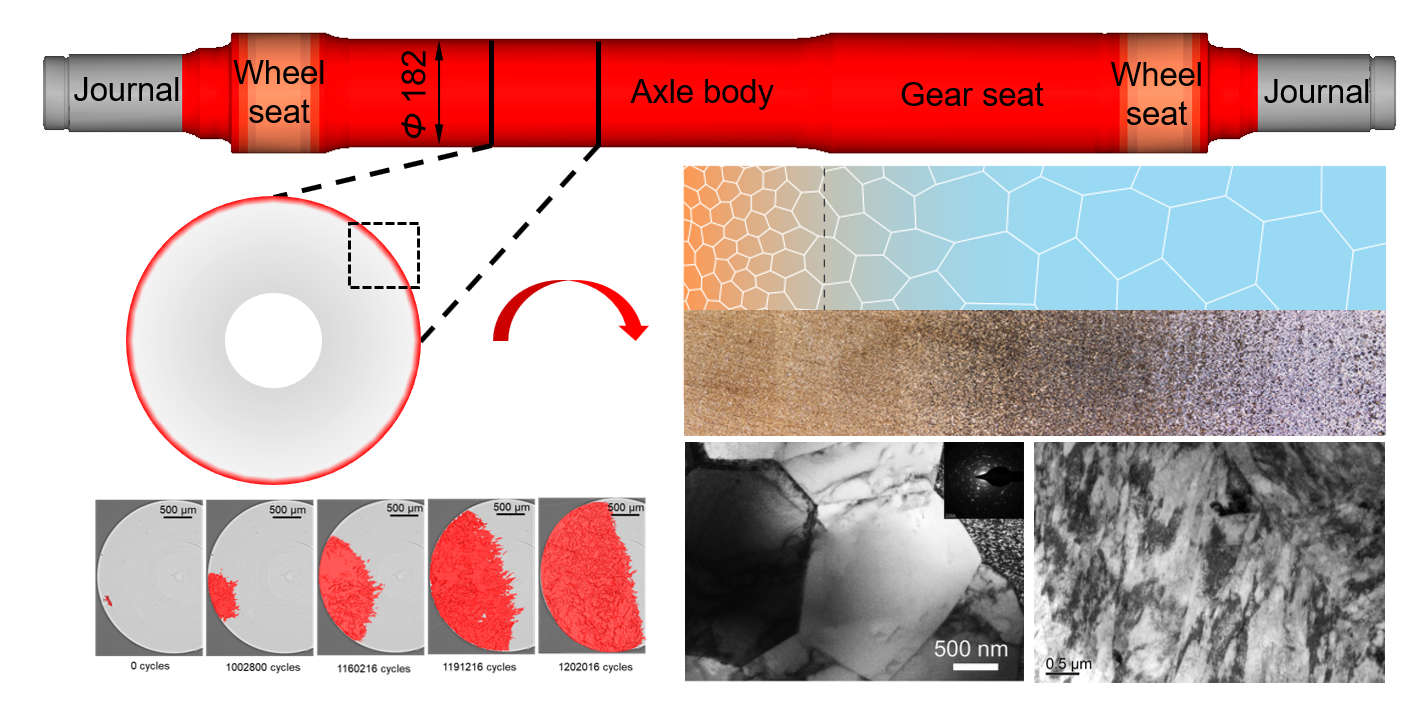
This research direction focuses on the mechanical behavior, damage mechanisms, and performance enhancement of key rail transportation components under complex service conditions. It primarily addresses critical scientific issues related to fatigue fracture, wear, and surface modification in core components such as the wheel-rail contact system and axles. The research integrates contact mechanics, fracture mechanics, material surface engineering, and multi-scale simulation methods, aiming to bridge fundamental mechanistic studies with technological applications to enhance the safety and reliability of rail transportation equipment.
In the area of
fracture mechanics of wheel-rail contact, the focus is on investigating the damage evolution mechanisms of wheel-rail materials under the combined effects of rolling contact fatigue, wear, and electro-chemical/electrical currents. Research involves the formation and failure of interfacial tribochemical reaction layers, the absorption and diffusion behavior of hydrogen atoms under cyclic stress, and the influence of hydrogen-induced damage mechanisms (such as hydrogen-enhanced localized plasticity and hydrogen-induced decohesion) on crack initiation and propagation. Through multi-scale characterization and simulation, the study reveals the laws governing wear, recrystallization, precipitate evolution, and crack propagation in wheel-rail materials under complex working conditions, providing a theoretical basis for lifespan prediction and performance optimization of these materials.
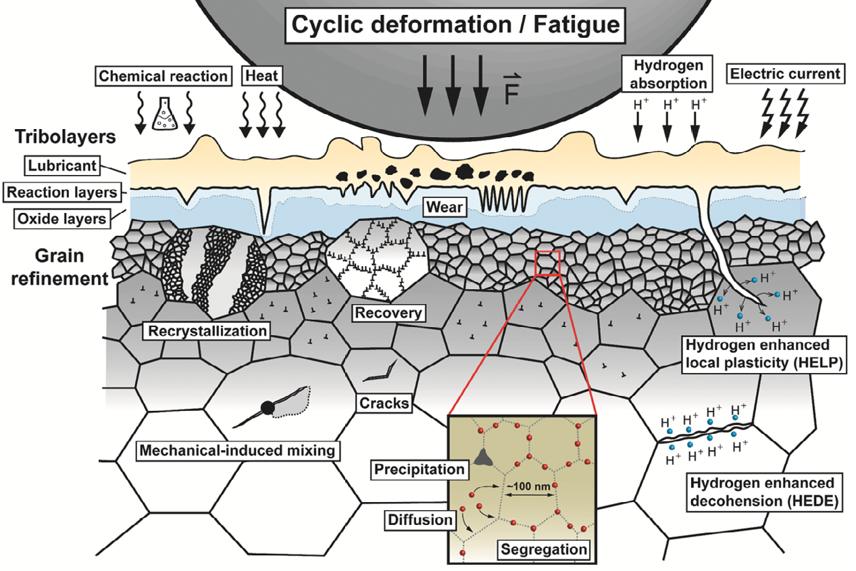
轮轨接触中疲劳与断裂力学(马普钢铁所)
In the area of
laser quenching for axle strengthening
, the research emphasizes the application of high-energy laser surface modification technology on critical sections of axles (such as journals, wheel seats, and gear seats). The goal is to fabricate gradient nanostructured hardened layers on axle surfaces via laser quenching, studying the evolution of the hardened layer's microstructure, residual stress distribution, and their impact on fatigue strength, wear resistance, and corrosion fatigue performance. The research systematically evaluates the effectiveness of laser strengthening processes in enhancing the full-lifecycle reliability of axles, offering technological support for the lightweight design, extended service life, and intelligent remanufacturing of key rail transportation components.