
 中文
Current position: Home > Research > Paper Publications
Paper Publications
Dispersive atomization-assisted self-assembly: Vapor-phase direct-write of conformal colloidal monolayers on arbitrary 3D surfaces
Impact Factor:5.4
DOI number:10.1016/j.colsurfa.2026.142084
Affiliation of Author(s):西南交通大学
Teaching and Research Group:智能制造与装备系
Journal:Colloids and Surfaces A: Physicochemical and Engineering Aspects
Key Words:Dispersive atomization-assisted self-assembly; Air-liquid interface assembly; Conformal monolayers; Defect annealing; PS and PMMA nanoparticles
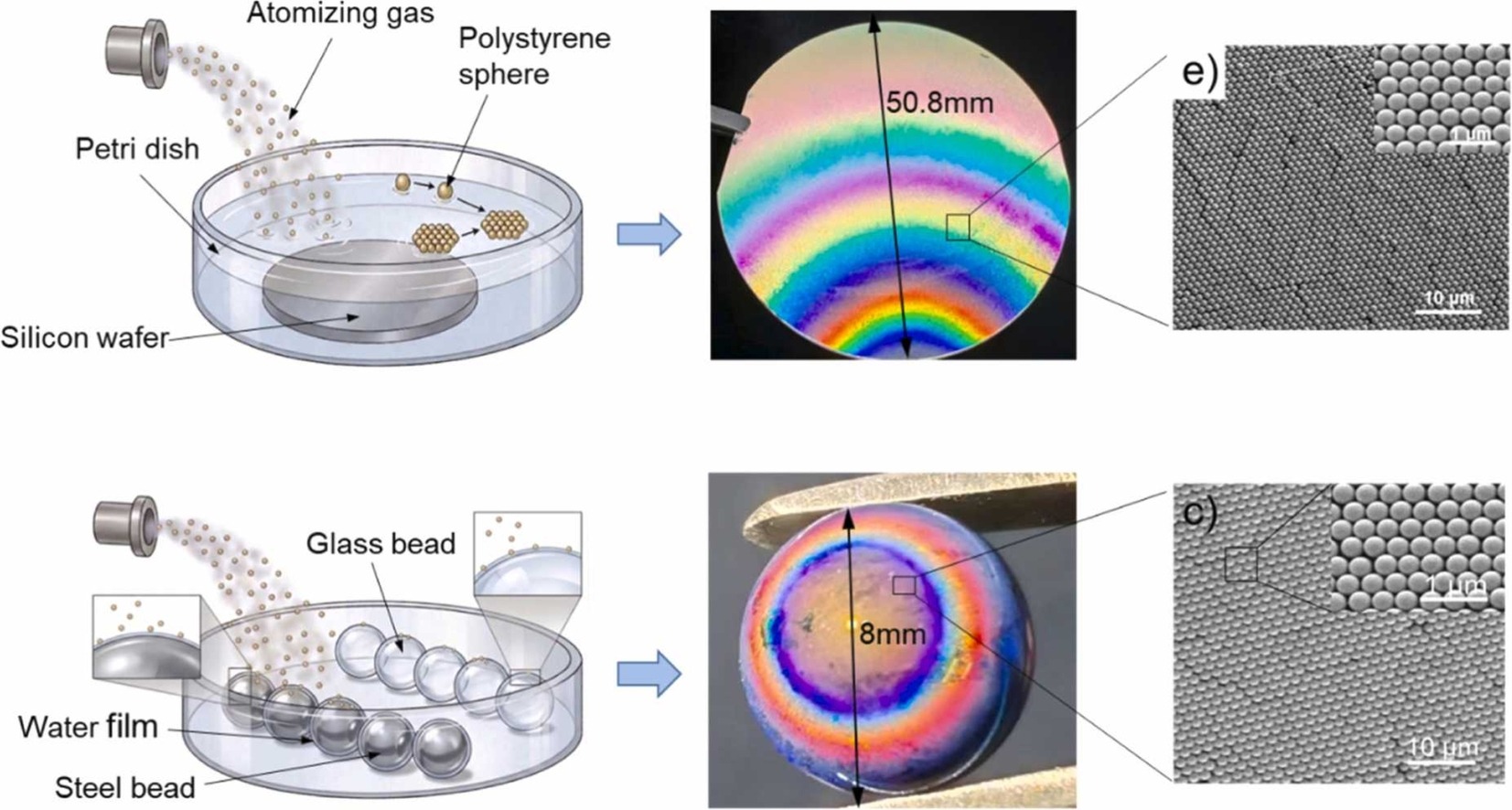
Abstract:The scalable fabrication of large-area, defect-minimized monolayer colloidal crystals remains a critical bottleneck for their deployment in nanophotonics, multimodal sensing, and soft robotics. Conventional bottom-up approaches are plagued by coffee-ring effects, shear-induced cracking, multilayer stacking, and poor geometric adaptability, particularly on non-planar substrates. Here, we report dispersive atomization-assisted self-assembly (DAASA), a robust and low-cost strategy that enables wafer-scale production of highly ordered, near-defect-free monolayers. In contrast to previously reported aerosol-assisted assembly, in which particles are supplied continuously and ordering must keep pace with an uninterrupted flux, DAASA meters the aerosol in short pulses separated by quiescent intervals; delivery and assembly are therefore decoupled in the time domain, and each dose is followed by a defined window for capillary-driven defect annealing. By decoupling particle delivery from interfacial assembly, DAASA leverages precisely controlled aerosol deposition onto an air-liquid interface, where capillary forces and tuned colloidal interactions drive spontaneous long-range ordering. Systematic optimization of substrate wettability, ionic strength, solvent surface tension, and, critically, an intermittent atomization protocol yields high film uniformity and crystallinity. Most notably, and in contrast both to strategies that order the particles on the target surface itself and to those that require a post-assembly transfer, DAASA transcends planar geometries: it achieves transfer-free, conformal monolayers directly on complex 3D curved surfaces via a vapor-phase direct-write mechanism, eliminating both liquid immersion and post-assembly transfer. This gentle, non-destructive nanomanufacturing paradigm opens transformative pathways for structural color, metasurfaces, wearable sensors, and bioinspired soft systems.
Co-author:Xihong Huang,Yucong Mao,Yu Tong,Yifan Zhang,Zhi-jun Zhao,Bingjun Yu,Linmao Qian
First Author:Bin Song
Indexed by:SCI
Correspondence Author:Hongbo Wang
Document Code:142084
Discipline:Engineering
Document Type:J
Volume:753
Page Number:142084
ISSN No.:0927-7757
Translation or Not:no
Date of Publication:2026-09-03
Included Journals:SCI
Links to published journals:https://www.sciencedirect.com/science/article/pii/S0927775726026245?dgcid=author
Attachments:
Hongbo Wang
Lecturer (higher education)
Supervisor of Master's Candidates